High Technology Lends a Hand
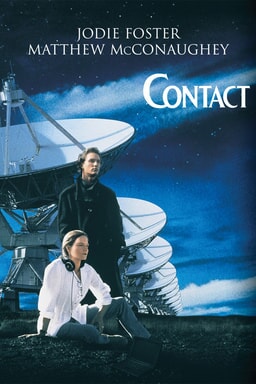
In Sagan's book as in Zemeckis' realization, "Contact" begins when Ellie intercepts a message while sweeping the skies with the help of gigantic radio telescopes. The site utilized for both is the Very Large Array, or VLA, a field of 27 linked dish-shaped radio telescopes located in the desert of Socorro, New Mexico. The VLA, a facility of the National Science Foundation, is used by astronomers to study the physical processes by which the sun, planets, comets, stars, galaxies and gas clouds throughout the universe produce radio waves. Through their studies, scientists hope to learn more about celestial objects, and in the film, much of Ellie's research takes place at the VLA.
Principal photography commenced at the VLA in late September, to take advantage of the formation of the dishes when they were closest to one another, providing a stunning visual image across the remote desert. Although it was technically "the dry season" in the New Mexico deserts, the production nonetheless encountered every kind of inclement weather imaginable.
"Shooting at the VLA was, of course, spectacular but also one of the most
difficult aspects of our filming," says producer Steve Starkey. "It is a
working facility so in order for us to accomplish shots for the movie, we had
to negotiate with the National Science Foundation for 'dish control' in order
to move the dishes in the direction we needed to effect the most dramatic shot
for the story."
Miraculously and despite the small window of opportunity and unpredictable
weather, the production finished on time just as the dishes were scheduled to
be moved into a new formation to search other parts of the galaxy.
Science of the Soundstage
Following arduous first weeks of location filming in New Mexico and
Arizona, the production then returned to Los Angeles for five months' worth of
location and soundstage shooting utilizing a total of nine different
soundstages at Warner Hollywood Studios and the Culver Studios. (Zemeckis and
his team were not able to settle into uninterrupted soundstage shooting,
however; one month prior to completion of principal photography, filmmakers
shot for one week in Puerto Rico, at the gigantic Arecibo radio telescope.)
Production designer Ed Verreaux and set decorator MICHAEL TAYLOR recreated
dramatic yet realistic sets which frame the epoch-making events in the film. Their teams constructed over 25 sets, including the Cabinet Room of the White House, a tropical hut in the Puerto Rican rainforest, the massive and intricate control rooms of NASA and, perhaps most amazing, a machine of transport -- the Pod -- which makes intergalactic travel far beyond our current capability possible.
"Bob really thinks on a grand scale. He also thinks in multiple layers that
are not necessarily immediately accessible," says Starkey. "Those ideas and
layers continue to open up and surprise you, excite you, which is why it's
great to work with him. They can also confound you because you have to figure
out a way to deal with what he wants."
One of the choices Zemeckis made in enriching the story was the comprehensive use of television monitors and computer screens. Associate producers RICK PORRAS and STEVEN BOYD headed the unit that produced all video material for playback. It was this duo who worked with Zemeckis on "Forrest Gump" to secure the archival footage that was magically converted to show Forrest shaking hands with Kennedy or watching the first effort to desegregate the schools in Birmingham, Alabama.
The monitors and computer screens were also able to provide a sense of urgency
and accuracy to the broadcasting of the message, magnifying its global impact.
Says "Contact" computer and video supervisor IAN KELLY, "In virtually every
scene in the film, there are computer screens, video or television monitors of
some kind telling us more of the story. This seems only right, considering
that so much information about what happens in the world is imparted to us
through television screens."
Zemeckis elaborates, "If this actually happened, it would become a media
event, involving people like NASA and the government. It wouldn't just be a
science-fiction story where a spaceship lands in the backyard of a suburban
family. It would happen on the world stage."
One of the major contributions in creating a sense of realism was the
participation of CNN as the principal news outlet covering the world as it
reacts to the message. More than 25 news reporters from CNN had roles in
"Contact" and the CNN programs "Larry King Live" and "Crossfire" were also
included. Ann Druyan, Carl Sagan's widow and a noted writer, makes a cameo
appearance as herself, debating Lowe's character, Richard Rank, on "Crossfire."
Filmmakers held the same high standard of visual quality and realism when it
came time to create "the message," an enormous project that required the
contribution of Sagan along with scientists from SETI, JPL and Cal Tech.
"In the book, the message is received over a long period of time," says Kelly.
"That's a luxury we didn't have in the film, but we had to be believable in an
economical way. So we contacted our advisors from JPL and Cal Tech to ask them
how this message could be received accurately for the movie, but in less time.
They, in turn, detailed the calculations in a seven-page document about how the
message would be transmitted, and they forwarded it to Carl Sagan, who approved
it."
The actual decoding of the message (with its architectural drawings of
the transport) was created by Ken Ralston and Sony Pictures Imageworks. Ralston, who heads Imageworks, is collaborating with Zemeckis for the sixth time, after several of their previous outings netted him Academy Awards for visual effects. Imageworks crafted over 350 visual-effects shots for the film under Ralston's supervision.
Ralston and his team were charged with seamlessly integrating the film's
visual effects into the live-action photography, bringing the audience glimpses of never-before-seen galaxies. "We hope to be crossing the line where you're never sure what's an effect and what isn't an effect," says Ralston. "Despite how fantastic the images are, and some of the situations that Ellie winds up in, we still have to remain based in a certain type of reality that is established by the rest of the movie."
Imageworks used a combination of model and miniature shots and digital computer work, combined with principal photography from the film, to achieve the elaborate visual-effects sequences. "I think what you'll see is a type of heightened reality that helps the storytelling and takes us to worlds we haven't been to before in a believable way," concludes Ralston.
Director of photography Don Burgess, a Zemeckis veteran after "Gump" and
second-unit director of photography on the two "Back to the Future" sequels, agrees. "In all of Bob's movies and 'Contact' in particular, there are so many elements you're dealing with in just one shot. First of course, and most importantly, is the performance. Bob will always make the technology fit the creative vision before compromising the creative vision. But you are often adding to the story the technical elements of blue screen, several different angles being shot at once, computer screens, glass reflections and then the visual-effects needs. Needless to say, there are always exciting days on a Zemeckis movie and rarely easy ones."
Perhaps the most challenging work facing the filmmakers was the creation of a
vehicle representing a new type of intergalactic transportation, which is
constructed using the blueprints contained in the message from space. The
machine itself is a gargantuan structure that 'launches' a capsule -- called
"the Pod" -- containing the traveller. Verreaux describes it as "an enormous
machine composed of rings that are linear accelerators, creating a kind of
massive energy field or plasma vortex. The Pod, or the capsule, is dropped
into the center of the vortex, where a worm-hole is created, and the traveller in the Pod is transported to another point in the universe instantaneously."
The theory of worm-hole time/space travel, in fact, was first presented by
Sagan to the masses in his novel only after Sagan contacted renowned Cal Tech
physicist Kip Thorn to inquire if such space travel were possible. Thorn
expounded on Sagan's theory and provided the author with an essay -- in effect,
a "bible" for worm-hole travel -- which was diligently adhered to in the
story.
The director notes, "The machine in Sagan's novel was somewhat vague, which is
fine for a book. In a movie, though, if you're going to build a giant physical
structure of alien design, you have to make it believable. It had to be huge,
so that the audience would feel like it was bigger than man should be tinkering
with. It had to look absolutely real."
Early conceptual designs of the Pod itself were based, as it existed in the
novel, on one of the primary shapes in geometry, a dodecahedron or a
twelve-sided figure. Eventually the Pod was modified to a spherical capsule
that encases the traveller. Verreaux worked with designer Steve Berg drafting
early renderings of the capsule which is suspended 1,000 feet above and then
dropped into the center of the large atomic structure of the accelerator rings
of the machine. Designers at Sony Imageworks lifted visual references from
physics (the nucleus at the center of an atom) and nature (the pollination that
occurs at the center of a flower) for the massive machine.
Zemeckis and his team also made several visits to the Kennedy Space Center in
Cape Canaveral, where officials allowed them access to sites off-limits to most visitors. Filmmakers were brought onto Launch Pad V prior to the launch of the space shuttle. There, they concentrated on the mechanics of the elevator and the gantry area and loading arm. The resulting photographs and research were incorporated into the design of the machine's surrounding supports and gantry.
Once the concept met with the filmmakers' approval, physical construction
began on the sets for the Pod itself, the interior of the elevator and the
gantry, which took almost four months to build. (Sony Imageworks utilized
digital effects to create the remainder of the enormous machine.)
Upon completion of Pod filming, actual shots of the physical sets were
seamlessly blended with Imageworks' effects shots of the machine with its giant
vortex of spinning rings. Theoretical science and physics meet reality in an
awe-inspiring combination. Zemeckis believes, "There is a visceral, cinematic suspense in the Pod, a huge-scale danger -- but also an incredible beauty."
©1997 Warner Bros.